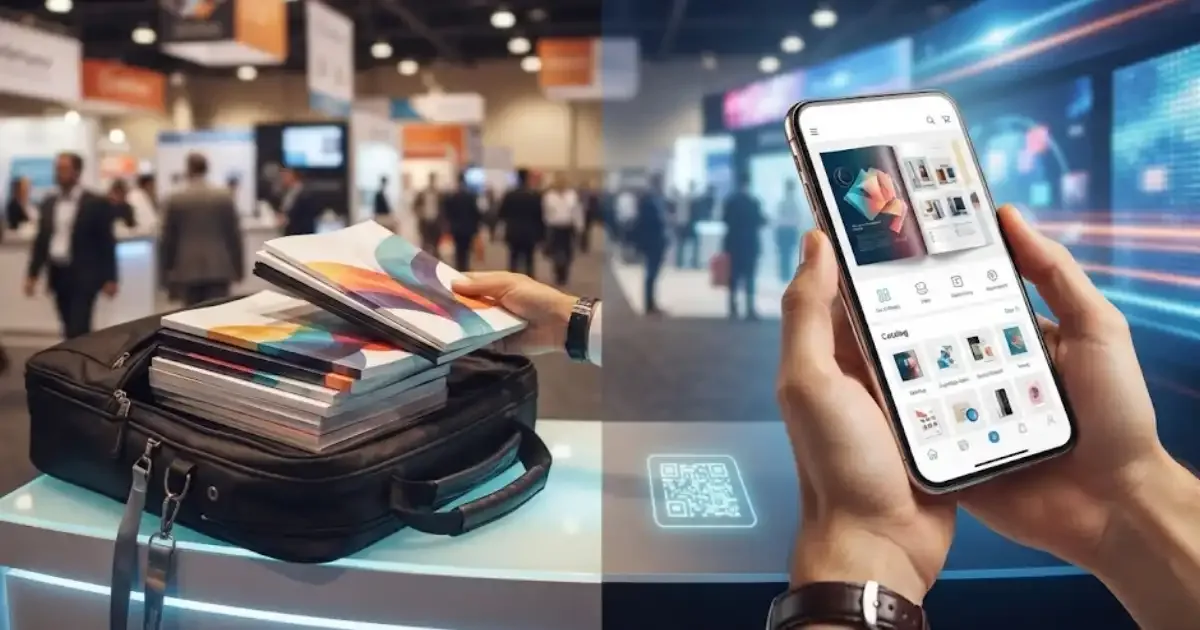
Everybody knows this. And yet we still order a thousand catalogs before every show, because when we have nothing else to hand over, it feels like we should be handing over something.
A digital catalog changes that habit. Instead of giving the visitor paper, you leave a link on the phone in their pocket.
How it works at the booth
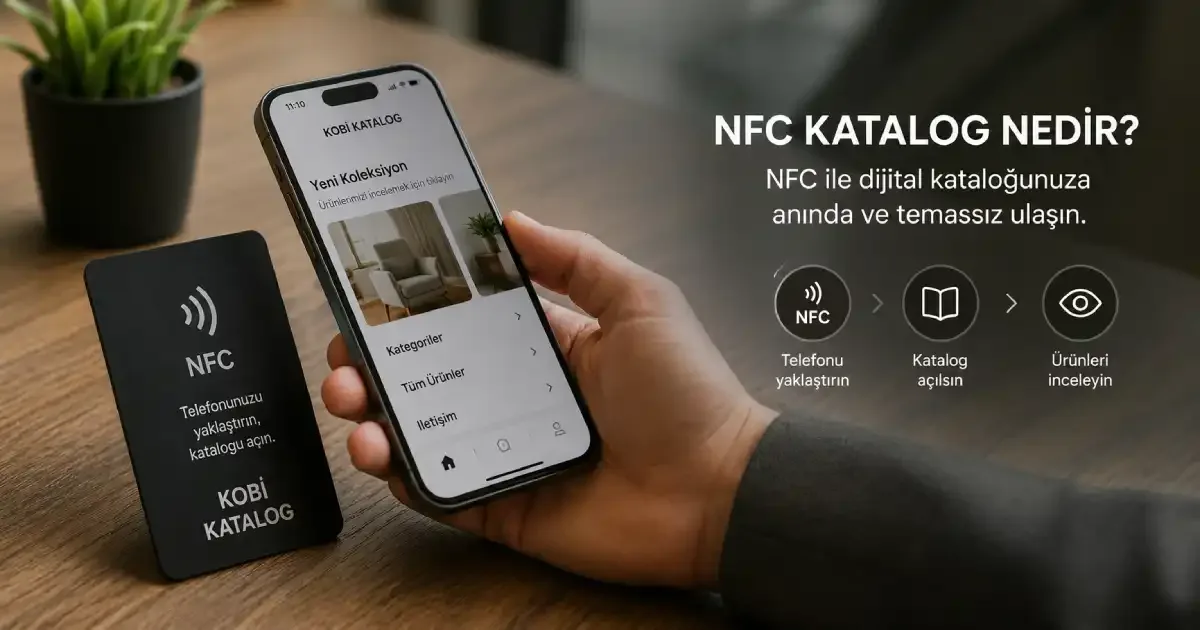
You put a QR code on your booth panel and an NFC card on the table. The visitor scans the code or taps their phone against the card, and your catalog opens. They browse on their own phone, save what interests them, and can request a quote right there.
The real gain is that the catalog stays with them. Paper gets left at the hotel; the link is still on the phone three weeks later. And the buying decision is usually made in those three weeks, not at the show.
Putting a QR code on the booth is not enough
The most common mistake at trade shows is printing a QR code and leaving it in a corner of the table. Nobody scans it, and then people conclude that digital catalogs do not work. A few practical points are worth following.
Say what the code is. A bare square makes nobody curious. A code labelled "Product catalog — scan here" gets read several times more often than an unlabelled one.
Put it at eye level. That A5 card on the table is invisible. Mount the code on the booth panel, at a height where someone standing can comfortably raise their phone.
Watch the finish. A code printed on glossy stock disappears under booth spotlights. Matte is safer.
Use more than one spot. Booth panel, table, business cards, product labels, even the team's badges.
The connectivity problem nobody mentions
This barely comes up in articles about digital catalogs, yet everyone who exhibits has lived it: once the hall fills up, the mobile network chokes. Thousands of people are hanging off the same cell, and pages stop loading.
The moment a visitor scans your code and then has to wait, you have lost them. So the thing that matters in a catalog built for trade shows is not ultra-high-resolution imagery, it is a page that still opens on a bad connection. A catalog that can work offline makes a real difference here.
What belongs in the catalog
A catalog that is nothing but product photos and a price list does not do much at a show. What the visitor needs after leaving your booth is this: product images with clear descriptions, technical specifications (in B2B the decision is usually made looking at that table), products grouped into categories rather than one flat list of fifty items, company details and certifications, a WhatsApp link, and a quote request form.
One note on pricing: if you would rather not have everyone at the show see your prices, keep them out of the public part of the catalog. Leave a quote form instead and give the price in conversation. Your competitors are at that show too, and they scan QR codes as well.
Language at international shows
At an international show, an English catalog is no longer an advantage, it is the minimum. The difference comes from the visitor seeing something in their own language.
Digital makes that far easier than print. The same link can open in a different language depending on the visitor's phone. Printing in three languages means three separate print runs; digitally it is one catalog, three languages.
What a digital catalog will not fix
Let us be honest about this. A digital catalog will not rescue a weak booth, will not increase your visitor traffic, and will not close the deal for you. What it does is leave a trace on the other side once the conversation ends.
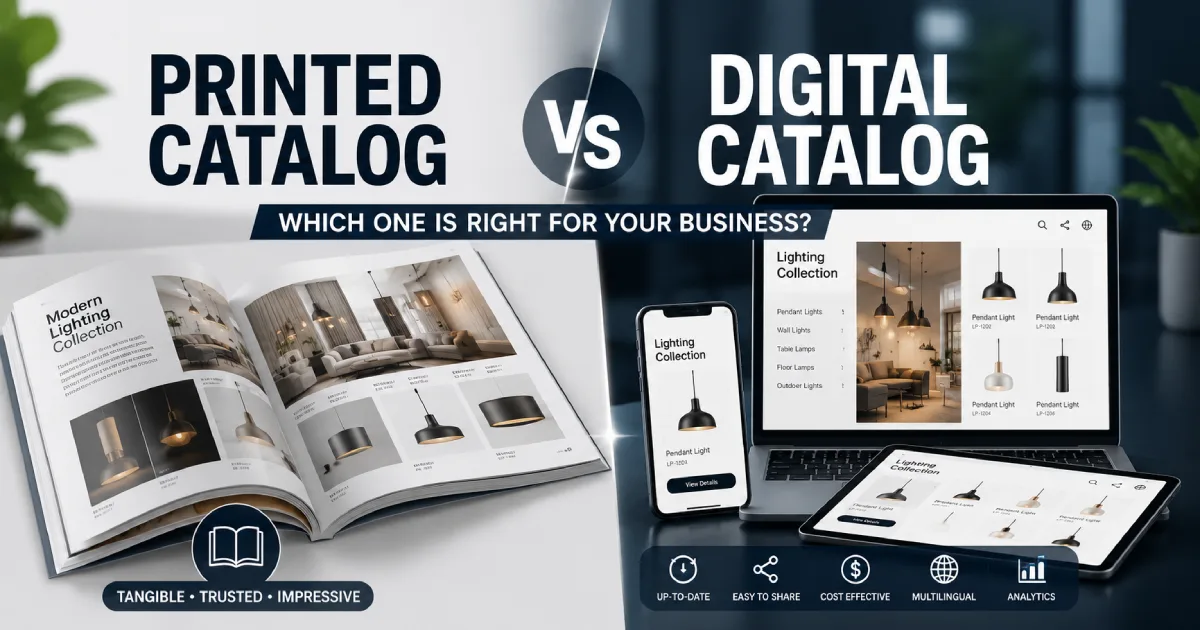
Paper does not disappear either. Some buyers still want something they can hold. The practical answer is to replace the thick catalog with a single-page summary sheet and print a QR code on it. The printing bill drops to a tenth, whoever wants paper gets paper, and the detail lives online.
Going to a show with KobiKatalog
KobiKatalog is a digital catalog system built for small and mid-sized manufacturers and distributors. The parts that matter at a trade show: QR and NFC access, multilingual content with text-to-speech, AI-assisted product search, and an offline-capable structure that still opens on a weak connection.
We print and program your NFC cards. When the show ends, the catalog stays at the same address; you update the content from the panel as it changes.
If you would like to travel to your next show with less paper, let's get your catalog ready now.
Frequently asked questions
Should I put a tablet on the booth or hand out cards?
They do different jobs. A tablet is good while you are presenting a product yourself, but when visitors are left alone with it, a queue forms and the booth clogs up. A card or QR code sends the visitor to their own phone, which is faster and leaves the catalog with them.
What if there is no signal in the hall?
If the catalog has been opened once, the PWA structure lets most of the content be viewed offline. That first load still needs a connection, which is exactly why a lightweight page matters.
What happens to the catalog after the show?
It stays at the same address. The cards you handed out and the links you shared keep working, and you update the content as it changes. So the catalog is not show-specific material, it becomes a permanent sales asset.
How many NFC cards should I order?
You do not have to hand a card to everyone. A few cards that stay in the team's pockets, get tapped by a visitor and go back in the pocket cover most of the work. Add a modest stack to leave with genuinely interested visitors and that is usually enough.
Will a digital catalog replace print entirely?
For most companies it does not replace it, it shrinks it. You print a hundred instead of a thousand, and a single summary sheet instead of a thick book. The print budget goes down and the number of people who actually see the catalog goes up.